|
Title: |
1893 Article-Ball & Wood Co., Cross-Compound Steam Engine |
|
Source: |
Cassier's Magazine Jul 1893, pg. 219 |
|
Insert Date: |
11/20/2012 9:52:31 PM |
|
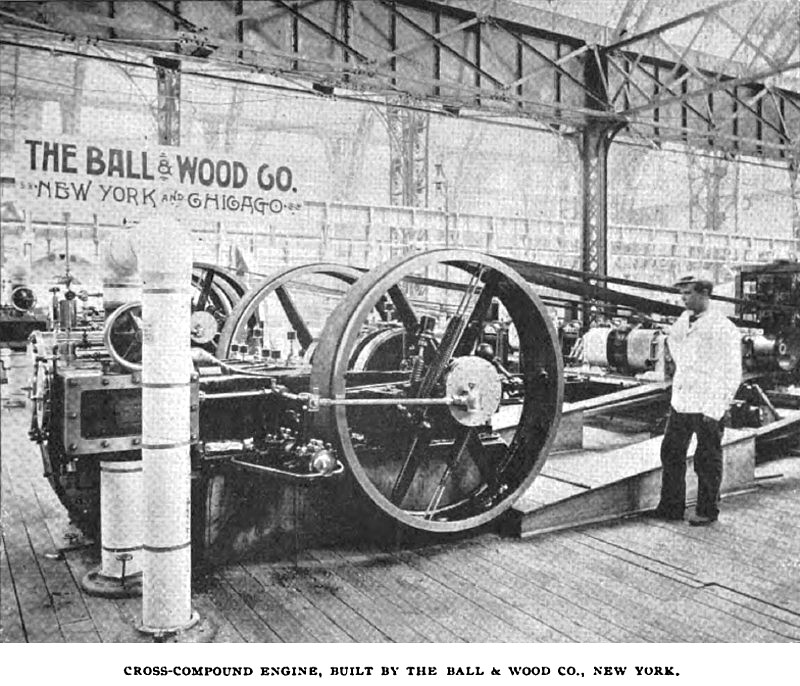
The Ball & Wood Company, of New York, show, altogether, five engines, the exhibit being made up of two of their simple automatic engines, with sixteen by sixteen-inch cylinders, rated at 150 horse-power each; two tandem-compound engines with extended base, cylinders measuring thirteen by twenty by sixteen inches, and also rated at 150 horse-power each; and one cross-compound engine of 200 horse-power, with cylinders measuring fourteen by twenty two by twelve inches. The engines are connected by belts to sixteen Brush dynamos, which furnish current for arc lights used in the Exposition grounds. General and detail views of the cross-compound and of one of the tandem-compound engines are given in this number. A feature of these engines which at once attracts attention is the arrangement of the low-pressure valves. It will be observed that the valve chest on the low-pressure cylinder is cylindrical in shape, and is placed transversely to the axis of the cylinder, and directly underneath it. In the sectional view, small arrows in the passages indicate the direction of the flow of the steam, and larger arrows in the moving parts show the direction of their motion. The valve chest is made very large in diameter, so that the steam ports are short and direct. Two double-ported valves, with arc-shaped faces fitting the bore of the valve chest, are placed opposite each other and are mounted loosely on a central valve stem which drives them both and allows both to be held in contact with their faces by steam pressure. Steam is admitted from the valve chest over the edge on the end of the valve, and also through the port in the valve, thus giving a very rapid and wide opening. At the same time the exhaust from the other end of cylinder, has a very direct passage to the condenser. The valve stem carries on its outer end a rock arm which receives motion from a simple crank pin on the outside of the balance wheel, thus dispensing with an eccentric and having all the parts easily accessible. The whole valve mechanism is made very simple by this arrangement, the number of parts is small, and the valves, as already intimated, give a wide and quick opening and follow up their wear with steam pressure. The clearance also is small owing to the short and direct ports, which, moreover, are so located, as will be understood from the illustration, that they readily drain away water accumulations from the cylinder and reduce the chances of accident from such accumulations. |
|
 1893 Ball & Wood Co., Cross-Compound Steam Engine
|
|