|
Title: |
1890 Article-George W. Tifft, Sons & Co., Corliss Steam Engine |
|
Source: |
The Steam User 1890 pg 6 |
|
Insert Date: |
4/13/2011 3:08:44 PM |
The engraving on the opposite page represents one of the Tifft-Corliss engines, containing several improvements which the manufacturers claim are quite important.
The girder bed is cylindrical in form, with a heavy flanged rib on the back, making a straight-line connection between the cylinder and the pillow-box stand. This design places the metal in the strongest possible form. The flange at cylinder end of the bed is bored so as to receive a ring cast on the stuffing-box cylinder head. In this way the stud bolts are relieved from carrying any weight of the bed. The slides are bored, and are very wide; giving ample wearing surface.
The cylinder is supported by two heavy stands, making a broad, rigid base. The exhaust chest below the cylinder is separated from it one inch, so the escaping steam does not chill the working steam.
The cross-head gibs are very wide, and are faced with the best babbit-metal, that is turned accurately to fit the slides. These gibs have a wedge-shaped back, and are adjusted along the guides by a set-screw, with lock nuts so arranged that it is possible to take the smallest amount of wear. The pin is cast steel, very large, fitted tapered shanks into the cheeks of the cross-head, where it is held on the back with a heavy nut.
The bronze boxes of the connecting-rod are held in place by wedges that are full size of the back of the box, and are adjusted by screw bolts that are locked with check nuts.
The main bearing is lined with the best babbit-metal. The quarter boxes are held in place by wedges at the back, that are adjusted and locked from the cap of the box.
The shaft and crank are forged of ample size to insure long life. The wrist-pin is cast steel, very large, fitted with a tapered shank, and on the larger sizes it is held in place with a key at the back. There is an oil hole from the outer side, drilled at the axis of the pin, to the centre of the wrist bearing, where it meets another hole drilled radially with the crank. By this means the crank-pin can be oiled with a stationary oiler while the engine is in motion. The same plan is used on the cross-head pin.
The arms of the steam valve bonnets are turned eccentric with the valve rods. On this is fitted a loose eccentric that is operated by the governor. The tripping arm is fitted to this outer eccentric by this double movement for shortening and lengthening the distance between the valve centre and the tripping toe, a positive valve gear is obtained that is very sensitive, and we also do away with the springs on the latch, and depend on gravity only, that is most reliable to replace it after the tripping toe has been passed. Several of these engines have been placed in the large grain elevators in Buffalo during the past few months.
(These engines are built by Geo. W. Tifft, Sons & Co., Buffalo, N. Y.) |
|
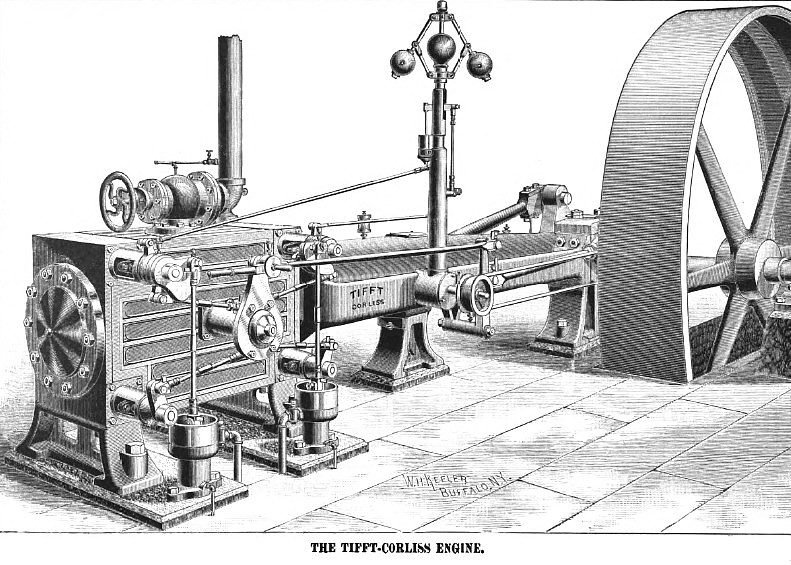 1890 George W. Tifft, Sons & Co., Corliss Steam Engine
|
|