|
Title: |
Nelson W. Twiss, The Twiss Corliss Engine Valve Gear |
|
Source: |
Power & the Engineer, V30, 08 Jun., 1909, pg. 1035 |
|
Insert Date: |
7/5/2026 4:21:43 PM |
The Twiss Corliss Engine
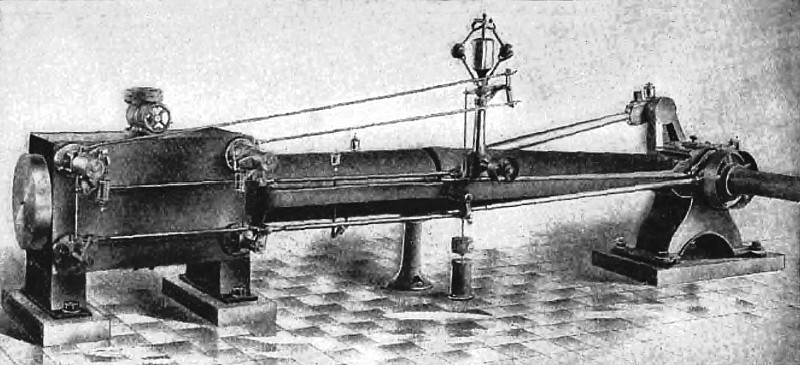
In Fig. 1 is shown the general lines of the Twiss Corliss engine manufactured by Nelson W. Twiss, 28 Whitney Avenue, New Haven. Conn. The frame is of the well-known Corliss girder type, the cylinder. frame and pillow block being cast separately and bolted together. The cylinder is provided with four double-ported Corliss valves the exhaust valves bring of the plug type with exhaust ports cored through them, thus securing a minimum amount of clearance. The steam valves are constructed to raise from their seats whenever the pressure in the cylinder exceeds the pressure in the steam chest. The valves are driven by means of suitable lugs or project ions on the valves and corresponding recesses in the valve stems. The exhaust valves are operated by arms keyed to the outer ends of the valve stems, the arms being connected by an adjustable rod and operated through suitable connections, as is usually found in the Corliss type of engine.
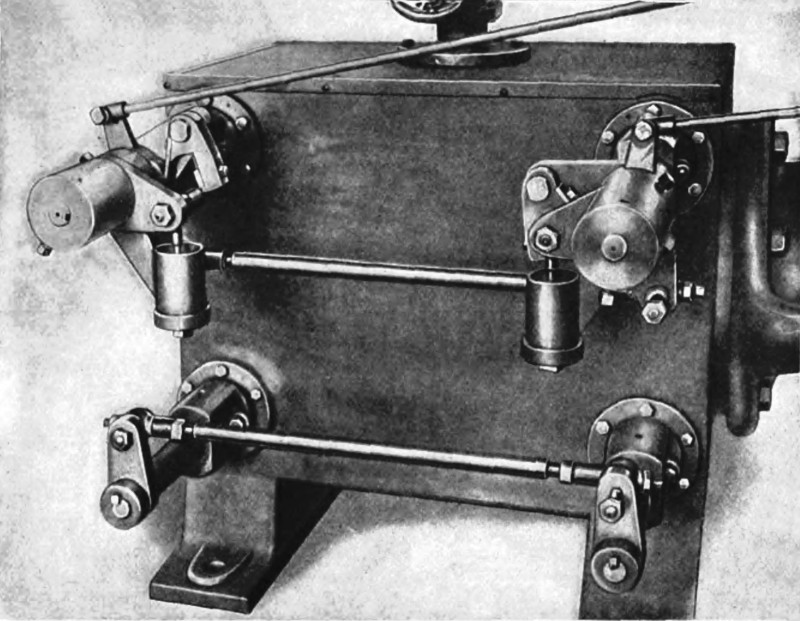
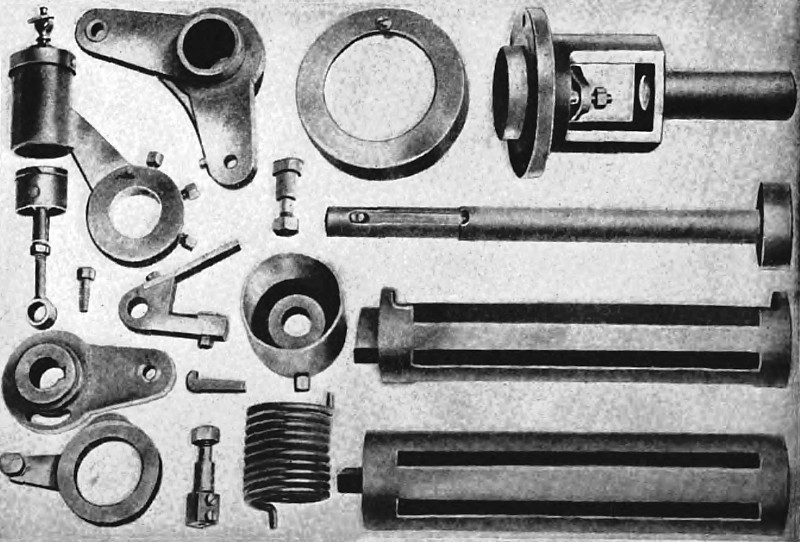
The main feature of this engine is the construction of the steam-valve gear, which is shown in Fig. 2. In Fig. 3 are shown all of the parts found in the valves and valve-gear construction. An explanation of the valve gear follows:
On a fixed extension of each steam bonnet, a bell-crank lever is journaled, the two being connected by an adjustable rod and operated by means of an eccentric rod: the eccentric rod not being shown in Fig. 2. On the arm of each bell- crank is pivoted the steam hook which engages with the steam arm keyed to the valve stem. The bell-crank levers engage the steam-valve hook as is usual with Corliss engines; that is. when one of the steam hook is engaged with die steam arm it opens the steam valve until the inner leg of the hook comes in contact with the trip toe on the knockoff lever, when it is di-engaged and the valve immediately closed by a spiral spring on the extension of the valve stem. The inner end of each spring is connected with the outer end of each steam bonnet, the outer end being connected to the cup which covers the spring and is secured to the valve stem by set screw- This provides a convenient method of adjusting the tension of the springs, and in order to do this it is only necessary to unscrew the set screws, shown in the cup, and with a small rod placed in the hole, shown on the right-hand valve, move the cup in the desired direction to adjust the spring with either more or less tension, as the case may demand.
On the Twiss engine no dashpots are employed, as the valves are closed by means of the wound spring, shown in Fig. 3, which is enclosed in the cup, shown at the end of the valve gear, Fig. 2. To ensure noiseless closing of each steam valve, an air-tight piston is secured to the steam arm of each, as shown, fitted with a suitable adjusting snap ring and fitted in the cylinder which is supported by a bracket secured to the outer end of each steam bonnet. The bottom of each air pot is fitted with a leather washer, having a hole in it communicating to the pet cock screwed in the bottom. In the side of the air cylinder, not over ½ inch from the bottom, is drilled a ?-inch hole which is covered before the plunger reaches the bottom of the cylinder, but as the plunger is raised above the hole, air is admitted which permits the plunger to travel the rest of its movements without undue force being exerted upon it. As the spring closes the valve, the plunger is forced down into the cylinder with a free, easy movement until it passes the hole in the bottom of the cylinder, when air is entrapped and is then compressed, thus preventing any shock in the seating of the steam valve. The amount of air confined in the cylinder and compressed is regulated by a pet cock screwed in the bottom but not shown in Fig. 2. By adjusting this pet cock the valve can be made to close practically noiselessly.
The knock-off levers are connected with the governor which regulates the point of cutoff as in all Corliss-engine construction. The exhaust valves are operated by a separate eccentric.
This valve gear can be placed upon any Corliss engine without making other changes. It is simple, does away with the cumbersome dashpot and admits of high speed for Corliss-engine operation.
US Patent: 1,006,808
https://www.datamp.org/patents/displayPatent.php?number=1006808&typeCode=0 |
|
 The Twiss Corliss Engine Valve Gear
 The Twiss Corliss Engine Valve Gear Side View
 The Twiss Corliss Engine Valve Gear Parts
|
|