Corner of Washington & Ohio Streets, Buffalo, NY.
|
|
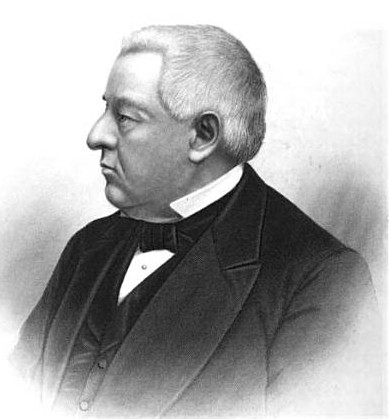
George W. Tifft
|
GEORGE WASHINGTON TIFFT
There are few if any names more prominently identified with the annals of Buffalo during the last forty years than that of George Washington Tifft. From 1842, when he became a resident of the city, until 1882, the year of his decease, he was an active, energetic, successful business man, largely engaged in a variety of industrial pursuits, and wielding an influence second to none of his contemporaries. This position was secured and maintained net alone by his unquestioned ability, but chiefly by unswerving integrity, indomitable perseverance and rigid fidelity to principle in the accomplishment of his purposes. Some men are so constituted that they are not content with the transaction of business on a small scale. They have an instinct to enlarge and extend their operations beyond the circumscribed tread-mill of retail methods, and are constantly seeking to utilize a combination of forces which may produce greater results than individual efforts are capable of accomplishing. It is to such men that the country is indebted for the organization of enterprises and the development of plans that result in the grand achievements that characterize this age of remarkable progress. It is not a quality that is acquired, it is inborn, and its possessor is incapable of restraining its forces, and naturally has enlarged ideas of things, and readily grasps and easily solves complicated business problems. Such men originate projects and devise methods where others are content to plod along in the aimless footsteps of their ancestors. No country has produced more men of this character than America, and no other country presents such opportunities for their development. Its institutions, resources, capabilities, business methods combine to offer unparalleled advantages for the development of genius and talent in those who possess these qualities. Doubtless much must be allowed for circumstances and conditions. Success is not always a true test of merit, although it is perhaps too often conceded to be. But when an individual overcomes adverse conditions and succeeds in spite of them, he evinces real genius and true greatness. The biographical sketch of such a man is a matter of public interest, especially to a community in which the life has been spent. Mr. Tifft was preeminently a man of this type. He was born on the thirty-first of January, 1805, and was the youngest of a family of twelve children—eight sons and four daughters, all of whom lived to the age of manhood—that were born to John Tifft and milling operations, doing a very large and successful business, and securing a position among the leading moneyed men of the city. In 1844, the International Bank of Buffalo was established largely by the influence and support of Mr. Tifft, and he was selected as the first president, which position he filled until 1857, the year of the great financial crash which carried down so many banks and commercial houses. There were few business men who were not affected by the panic of that eventful year, and failure was the rule rather than the exception. Mr. Tifft was a heavy endorser for the Buffalo Steam Engine company, for which he had to pay nearly one hundred thousand dollars, and therefore he was compelled like many others to suspend. The creditors of the concern for which he was an endorser gave him an extension of four years, and he took charge of its affairs, and under his management and superior financiering skill the whole indebtedness was paid off in two years, or one-half of the time allowed. About the time of the crash of 1857, Mr. Tifft had made heavy advances upon coal lands in Mercer county, Pennsylvania, and this property also came into his hands as had that of the Steam Engine company. In utilizing these coal lands he built two blast furnaces, in addition to one already on the property, and conceived the idea of smelting Lake Superior ore with mineral coal. His experiments in this matter were a success, and to him belongs the credit of having demonstrated the practicability of using mineral coal in treating this ore. In neglecting to cover his discovery by letters patent, he lost an opportunity to add immensely to his gains. He purchased a fleet of vessels and transported the ore from Lake Superior to Erie, which was taken thence to his furnaces in Mercer county, Pennsylvania. In 1858 Mr. Tifft was chosen president of the Buffalo, New York & Erie railroad, which is an extension of the Erie road from Corning to Buffalo by the way of Bath, Avon, Batavia and Attica. The organization is still in existence, and the New York, Lake Erie & Western railroad is the lessee of the line. About this time he turned his attention to the improvement of the real estate of which he had become possessed, and was one of the most extensive builders in Buffalo. In one year, 1863, he erected seventy-four dwelling houses, besides the Tifft house, for several years the principal hotel of the city, and an elevator, which was subsequently disposed of to the Erie Railroad company. He afterwards built the magnificent brick fire-proof Tifft elevator at a cost of $700,000 that was sold to the Central Railroad company in 1879 for $355,000, showing a wonderful depreciation in elevator property. Mr. Tifft was the owner of six hundred acres of land in the southern portion of Buffalo, bordering on Lake Erie, long known as the "Tifft farm." Its value greatly enhanced upon his hands, and was eventually sold to Pennsylvania capitalists, by whom it was subsequently leased to the Lehigh Valley Railroad company for a term of fifty years for an annual rental of $20,000 upon condition that $ 1,000,000 should be expended in improvements, and it is used in providing terminal facilities for handling coal and other heavy freight at that point. He became the owner of a farm of five thousand acres in Shelby county, Iowa, which was well stocked and highly cultivated and from which an annual harvest of fifty thousand bushel of grain was gathered. His investments and operations were not only numerous and diversified, but always upon a large scale and generally with successful results. Any venture in which Mr. Tifft engaged was an incentive for others to embark in the enterprise. His excellent judgment, business tact and unyielding integrity were assurances of ultimate success. The latter years of Mr. Tifft's life were devoted chiefly to the management of the Buffalo Engine works, a private stock company, the shares of which were held by members of his family and the business done under the name of George W. Tifft Sons & Co. It was and is one of the most extensive concerns in its line in the country, giving employment to four hundred operatives and support to more than a thousand persons. Mr. Tifft was largely interested in the manufacture of furniture in connection with the firm of Albert Best & Co., which was one of his unfortunate ventures, and which resulted in a loss of $150,000. Amid all the changes, the ups and downs of life, Mr. Tifft always maintained an unimpaired credit. His obligations were held sacred, whether as principal or endorser, and he never failed to pay one hundred cents on the dollar for every obligation assumed and required to meet. He was a bold, courageous operator, ready to assume risks, yet exercised good judgment as to the chances of success. He was emphatically a broad-gauge man, with remarkably comprehensive ideas especially in business affairs. No difficulties seemed insurmountable, and opposition only inspired greater efforts and a stronger determination to win. Such a man will succeed under less favorable circumstances than attended the career of Mr. Tifft. He was therefore entitled to a place in the front rank of the many prominent and successful businessmen of his time. Mr. Tifft always manifested a deep interest in public affairs, although never seeking or consenting to accept office. He was constable and collector in his native town of Nassau when twenty-two years old, and this is the only office he ever held. His taste was for business rather than for office, and in this he found more pleasure as well as greater profit. It were better for the country if he had more emulators of his worthy example. He was an active supporter of the Republican party, a great admirer of President Lincoln, and gave largely from his princely fortune for the support of the war, in furnishing substitutes for the army, and providing for the sustenance of soldiers' families during their absence. He was a generous and cheerful giver to charitable and benevolent objects, but not ostentatious in his gifts, and the hundreds who have been the recipients of his favors, privately bestowed, have learned to know and appreciate the nobleness of their benefactor. One of his principal charities was the endowment of the Ingleside Home, with a free gift of property valued at fifty thousand dollars. No worthy object appealed to his purse in vain. As he had been blest with prosperity he was willing to use the large means entrusted to him in doing good to others. He was identified with the Presbyterian church for fifty years, and was always a strictly temperance man, never using spirituous liquors except medicinally. He hail a large, portly physique, tall and erect, weighing two hundred and thirty pounds, with a strong, robust constitution that carried him nearly to the limit of four score years. He passed away in June, 1882, after completing his seventy seventh year. The limits of this brief notice only permit a bare mention of the more salient points in the eventful career of the distinguished subject. From the time of his early start in life—before his majority to the time of his death—covering a period of sixty years of an active, busy life, Mr. Tifft was conspicuous in all the relations of life. When he was young his comrades and neighbors believed him capable of almost any undertaking, for he always made it a point to succeed. In later years his name was a tower of strength, and was sought in every movement requiring moral, social or financial support. He filled a large place in the affairs of the city he has done so much to build up. His name will long be enshrined in the hearts of a people that had learned to know his worth and appreciate his virtues. On the fourteenth of March, 1827, Mr. Tifft was married to Lucy Enos, daughter of Joseph and Thankful Enos, who died in 1871. Seven children were born to them, only two of whom—Mrs. Dr. C. C. F. Gay and Mrs. George D. Plimpton, survive.
Information Sources
-
Magazine of Western History by Magazine of Western History Co. Mar 1886 pg 544
-
American Steam Engine Builders: 1800-1900 by Kenneth L. Cope, 2006 page 239